Stripped envelope supernovae (SNe) are a type of core-collapse supernovae, whose hydrogen and helium envelopes were stripped before the SN explosion. Evidence suggests that binary interaction[1] is the clue mechanism that causes envelope stripping prior to the SN explosion (e.g. [2][3]).
One piece of direct evidence involves searching for surviving companions in supernova remnants. This approach is based on the widely studied SN-companion interaction of Type Ia SNe through theoretical modeling (i.e. [4][5][6]). The overall results show that the SN ejecta strips the companion envelope during the interaction, and the companions will survive with significant signatures lasting thousands of years: brighter, inflated, reddening, surface contaminated, and kicked by the momentum transfer. These changes enhance the chances of detecting surviving companions, as their increased brightness and color shifts make them more detectable and distinguishable from circumstellar material (e.g. [7]).
Although observations of surviving companions in CCSNe are rare, their number has been increasing. This paper sorted out four surviving stripped envelope SNe companions from the literature and compared their luminosity and effective temperature with theoretical models for the potential companion of SN 2020oi [8]. The observational data aligned with the evolutionary tracks of surviving companion models on the H-R diagram (see Figure 1, same with Figure 7 in the paper), and the only case with multiple-epoch observations, the companion star of SN 1993J, followed the expected trend of decreasing luminosity and changing color (effective temperature).
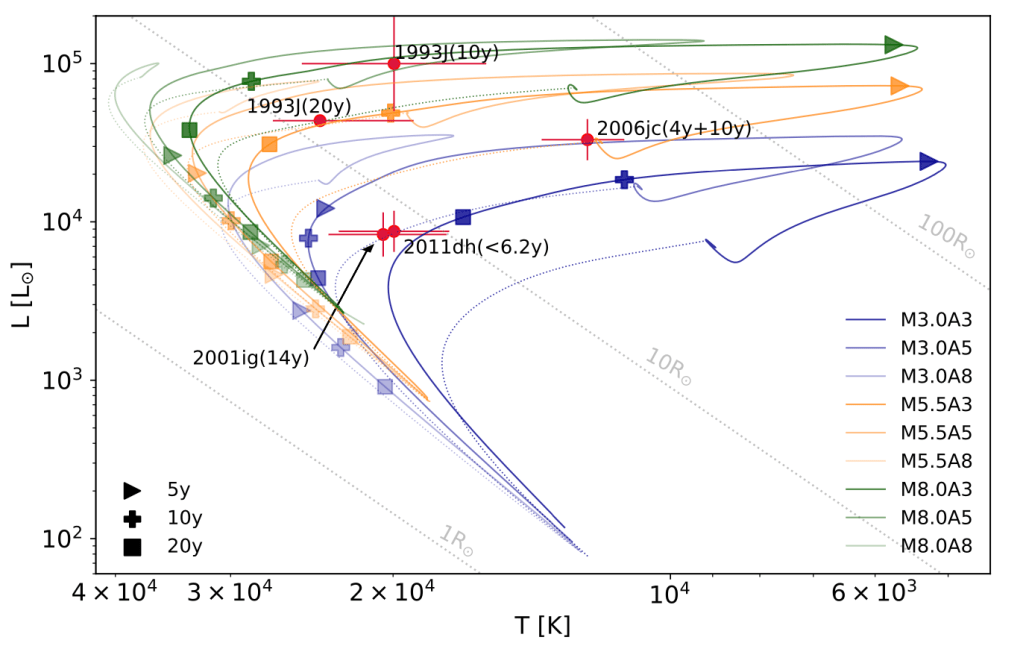
Our results indicate that a surviving companion becomes brighter by up to two orders of magnitude and temporarily redder following the SN impact. The companion might remain detectable with JWST for several years after the SN explosion. Furthermore, our prediction shows a significant gradient in magnitude around the peak, which could serve as another indicator for identifying surviving companions in stripped-envelope SNe.
Paper info
Title: Exploring the Observability of Surviving Companions of Stripped-envelope Supernovae: A Case Study of Type Ic SN 2020oi
Authors: Hsin-Pei Chen (陳昕霈), Shiau-Jie Rau (饒孝節), and Kuo-Chuan Pan (潘國全)
The Astrophysical Journal, 949:121, 2023 June 1
References
[1] Wheeler, J. C., Lecar, M., & McKee, C. F. 1975, ApJ, 200, 145.
[2] Sana, H., de Mink, S. E., de Koter, A., et al. 2012, Science, 337, 444.
[3] Prentice, S. J., Ashall, C., James, P. A., et al. 2019, MNRAS, 485, 1559.
[4] Fryxell, B. A. & Arnett, W. D. 1981, ApJ, 243, 994.
[5] Pan, K.-C., Ricker, P. M., & Taam, R. E. 2012, ApJ, 750, 151.
[6] Rau, S.-J. & Pan, K.-C. 2022, ApJ, 933, 38.
[7] Ryder, S. D., Van Dyk, S. D., Fox, O. D., et al. 2018, ApJ, 856, 83.
[8] Gagliano, A., Izzo, L., Kilpatrick, C. D., et al. 2022, ApJ, 924, 55.
 Hsin-Pei Chen